
 Children who begin ABA therapy earlier show significantly greater improvement across key life skills.
 Early childhood is a critical window for learning.
During this time, the brain is more adaptable – making it easier to build foundational skills like communication, social interaction, and daily routines.
Our outcomes study shows that children who begin therapy earlier experience stronger and faster progress.

Children who begin ABA therapy earlier show significantly greater improvement across key life skills.
In our outcomes study:
While all groups improved, the difference is clear: earlier start leads to stronger, faster gains.
The earlier therapy begins, the greater the long-term impact.
Early gains don’t just happen faster – they create a stronger foundation that children continue to build on over time.
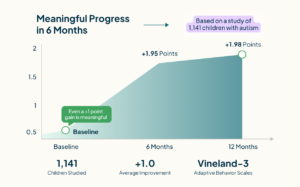
Early gains are just the beginning. Children continue to build skills over months and years.
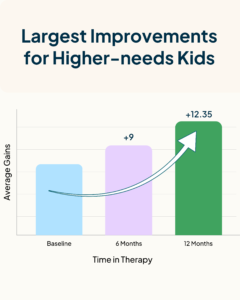 No – it’s never too late to start.
While earlier intervention leads to the largest gains, children of all ages can make meaningful, measurable progress with ABA therapy.
Older children may progress at a different pace, focus on different skill areas, or build more advanced or functional skills. But improvement is still very much possible.
What matters most is:
Progress doesn’t have an expiration date – it starts when you begin.

Progress isn’t just numbers – it’s what families begin to notice day to day.
Starting ABA therapy early can lead to:
These moments may seem small at first, but they add up quickly.
Over time, early progress helps children:
These early gains often become the foundation for long-term growth.
Every child’s journey is unique – but meaningful progress is possible.
We’ll walk you through:
Disclaimer: This outcomes study is based on a retrospective analysis of children receiving ABA therapy at Behavioral Innovations. Results reflect average changes measured using the Vineland Adaptive Behavior Scales (Vineland-3) over 6–12 months. Individual results may vary based on factors such as age, baseline skill level, therapy intensity, and individual needs. While improvements observed were statistically and clinically meaningful, outcomes are not guaranteed and should not be interpreted as typical for every child.