
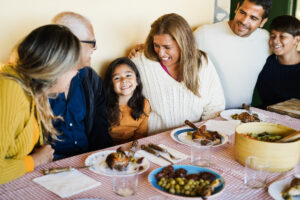
The holidays are a time to pause, reflect, and express gratitude for the people, experiences, and blessings in our lives. For many families, it’s a season of togetherness, shared meals, and meaningful traditions. While expressing thanks may come naturally to some children, children with autism often benefit from support in developing social-emotional skills, including recognizing the feelings of others, expressing gratitude, and connecting with family and friends. Applied Behavior Analysis (ABA) therapy offers a structured and effective way to help children with autism build these essential skills, fostering a sense of connection and appreciation that can enrich the holidays.
ABA is grounded in principles that help children learn skills in a systematic and positive way. Two core principles known as positive reinforcement and modeling are particularly useful when teaching gratitude and social connection.
Positive reinforcement involves rewarding desired behaviors to increase the likelihood that the behavior will occur again. For example, when a child says “thank you” after receiving a gift or help, immediate praise, a high-five, or a small token of recognition can reinforce the social skill. Over time, this repeated reinforcement helps the child understand that expressing gratitude is a positive, valued behavior.
Modeling is another key ABA strategy, where caregivers or therapists demonstrate the behavior for the child to observe and imitate. For instance, during Thanksgiving dinner, parents or siblings can model saying “thank you” to each other, sharing compliments, or expressing appreciation for food and efforts. Seeing these interactions provides a concrete example for children to follow.
ABA therapy also focuses on breaking down complex social-emotional behaviors into smaller, manageable steps. This is particularly effective for children who may struggle with abstract concepts like gratitude. Skills such as attending to others, offering verbal thanks, or sharing toys can be taught in sequential steps, with support gradually fading as the child becomes more independent.

The holiday season is a perfect opportunity to practice gratitude in fun and meaningful ways. Here are several practical ideas families can incorporate using ABA principles:
A gratitude board is a visual and interactive tool that helps children identify and express what they are thankful for. Families can use a large poster, whiteboard, or bulletin board and add pictures, drawings, or written notes representing people, experiences, or things the child appreciates.
ABA Tip: Pair each addition to the board with reinforcement. For example, if your child places a picture of a family pet on the board and says, “I am thankful for Fluffy,” offer immediate praise or a small reward. Over time, this encourages spontaneous expressions of gratitude.
Many children with autism respond well to visual support. Picture cards showing common situations such as receiving a gift, someone helping with chores, or sharing food can help children understand when to say “thank you” or show appreciation.
ABA Tip: Use errorless learning by first showing the correct response alongside the visual, then gradually removing the prompt as the child gains independence. Pair the behavior with reinforcement to strengthen the skill.
Incorporating gratitude into play makes learning social-emotional skills fun and meaningful. For example, during a pretend tea party or toy-sharing game, encourage your child to use polite expressions, acknowledge others, and take turns. Role-playing real-life scenarios, like helping set the table or complimenting a sibling’s contribution, can also provide practice.
ABA Tip: Reinforce each attempt at social interaction, even if it’s imperfect. Over time, these repeated practice opportunities help children generalize skills to real-life situations.
A gratitude jar is another hands-on activity. Each family member can write or draw something they are thankful for on slips of paper and place them in the jar. At the end of the day or week, the family can read them together. This activity encourages reflection and highlights the importance of noticing positive experiences and contributions from others.
ABA Tip: Use shaping to build the skill. If your child struggles to write or verbalize their gratitude, start with pointing to pictures or using symbols. Gradually increase the complexity of the expression as the child becomes more confident.

Holiday meals provide natural opportunities for practicing gratitude. Narrating your own thoughts out loud such as saying, “I am thankful for our roasted turkey” or “I appreciate that Sarah helped set the table” provides real-life modeling. Encourage your child to participate, offering cues or prompts as needed.
ABA Tip: Use prompting hierarchies to guide your child. Start with verbal prompts, then fade to gestural or visual cues, and finally allow independent responses. Celebrate each success to reinforce the behavior.
Teaching gratitude is more than just saying “thank you.” It promotes emotional awareness, empathy, and social connection, which are foundational for meaningful relationships. Children who learn to recognize and express appreciation develop a stronger understanding of others’ feelings, contributing to smoother social interactions and improved family dynamics.
Moreover, gratitude practices can support mental health and well-being. Even small expressions of appreciation like acknowledging a kind gesture or recognizing a family member’s effort can boost positive emotions, reduce stress, and strengthen resilience. For children with autism, who may face challenges in interpreting social cues, these structured opportunities for expressing gratitude are particularly valuable.
ABA encourages celebrating small victories along the way. Every time a child successfully expresses gratitude, shares with a sibling, or responds to a model, it is an opportunity to reinforce and celebrate the skill. Making the learning process joyful and interactive ensures that children not only acquire the skill but also associate it with positive experiences.
During the holidays, families can combine ABA strategies with holiday fun: sing songs about thankfulness and joy, create arts and crafts that represent what the child is grateful for, or play gratitude-themed games. These activities make learning social-emotional skills an enjoyable part of the holiday routine.

The holidays are a perfect time to focus on gratitude, connection, and appreciation. For children with autism, ABA therapy provides structured tools to help develop these essential social-emotional skills. By using strategies such as positive reinforcement, modeling, and visual supports, families can teach children how to express thanks, share with others, and recognize contributions in meaningful ways. Activities like gratitude boards, jars, role-playing, and visual supports turn abstract concepts into concrete, manageable steps.
This Holiday Season, integrating ABA strategies into everyday interactions not only strengthens social-emotional skills but also creates opportunities for deeper family connection and shared joy. Teaching gratitude is a gift that keeps giving which helps children build empathy, connection, and happiness that extends far beyond the holiday table.