ABA Therapy for Children with Autism
Behavioral Innovations operates more than 120 ABA therapy centers across six states, providing center-based applied behavior analysis for children ages 18 months to 10 years.
Every program is designed and supervised by a Board Certified Behavior Analyst, delivered one-to-one in a center, and built from individual assessment. Medicaid accepted.

Evidence-Based Therapy
What is Applied Behavior Analysis?
Applied behavior analysis is a therapy that teaches skills and reduces challenging behavior by identifying what triggers and maintains a behavior, then systematically teaching a functional alternative. It is the most extensively researched intervention for autism.
In practice, ABA therapy means a treatment plan written specifically for one child, delivered in structured sessions by a trained therapist, with data collected on every goal and the plan revised when the data says it should be.
Recognized as evidence-based by
American Academy of Pediatrics
U.S. Surgeon General
National Institute of Mental Health
Your Clinical Team
Who provides ABA therapy for children with autism
ABA therapy is delivered by a two-tier clinical team. Understanding the difference matters when you are comparing providers.
Board Certified Behavior Analyst
BCBA · Designs & Supervises
- Master's degree in behavior analysis or related field
- Minimum 1,500 hours of supervised fieldwork
- Passed national BCBA board examination
- Maintains certification through continuing education
- Conducts the assessment, writes the treatment plan, sets goals
- Supervises all RBT-delivered therapy sessions
At Behavioral Innovations
Your child's BCBA is present in the center, reviewing session data, adjusting goals and speaking with you directly. Supervision is how the program runs, not a signature at the end of a report.
Registered Behavior Technician
RBT · Delivers Therapy
- 40-hour training program in ABA fundamentals
- Passed national RBT competency assessment
- Passed national RBT certification exam
- Delivers direct one-to-one therapy sessions
- Works under ongoing BCBA supervision
- Records session data on every programmed goal
Supervision Model
RBTs deliver direct therapy under ongoing BCBA supervision. The BCBA reviews data from every session, not just at scheduled intervals.
Autism diagnostic evaluations, where offered, are conducted by licensed psychologists. In Texas and Colorado, Behavioral Innovations provides evaluations so families can complete testing and begin therapy with the same organization. Schedule an evaluation
Choosing a Provider
Choosing an ABA therapy company
ABA providers differ more than most families expect. Five questions separate them.

- 1
Who writes and supervises the plan?
Ask how many supervision hours your child's BCBA provides and whether that BCBA works in the center your child attends.
- 2
Is the program individualized or standardized?
Look for a plan built from a comprehensive functional assessment with measurable goals tied directly to that data.
- 3
How is progress measured?
Session-level data is the minimum. Ask whether the provider measures outcomes at the program level using a standardized, nationally normed instrument.
- 4
Is parent training built in?
Skills learned in a center have to generalize at home. That requires structured caregiver instruction as a program component, not an occasional meeting.
- 5
Is insurance handled before you commit?
Benefits verification, prior authorization timeline and expected out-of-pocket cost should be clear before your child's first session.
Our Process
How ABA therapy works at Behavioral Innovations
Seven stages, from first conversation to graduation. Every step is deliberate and data-driven.
- 1
Intake and Insurance Verification
We verify your benefits, confirm what your plan authorizes and tell you the expected cost before anything begins. You do not need a referral to start this conversation.
- 2
Comprehensive Assessment
A BCBA assesses your child's current skills across communication, behavior, social interaction, daily living and learning readiness, and interviews you about priorities at home.
- 3
Individualized Treatment Plan
The BCBA writes a plan specific to your child: target skills, behavior intervention strategies, measurable criteria for each goal, and a recommended intensity. Typically 20 to 40 hours per week, set by assessment, not a standard schedule.
- 4
One-to-One Therapy In-Center
An RBT delivers daily sessions under BCBA supervision in a purpose-built space with structured teaching areas, natural-environment teaching space and social skills group rooms.
- 5
Data Every Session
Every programmed goal is measured every session. Your child's BCBA reviews the data and adjusts targets when the data indicates, not on a fixed calendar.
- 6
Parent Training Throughout
You receive structured instruction in the same procedures used in the center, so the skills carry into home routines from the start.
- 7
Reassessment and Transition
Plans are formally reassessed at defined intervals. As goals are mastered, intensity reduces, and discharge planning begins when a child meets goals consistently across settings.
What ABA Addresses
Six domains. One individualized plan.
ABA therapy at Behavioral Innovations is built from a comprehensive assessment across six skill domains. No two children's plans are the same; goals are specific to each child's profile, strengths and priorities at home.
Recommended intensity typically ranges from 20 to 40 hours per week and is set by assessment, not by a standard schedule. Data is collected every session on every programmed goal. Goals are revised when the data indicates, not on a fixed calendar.
Communication
Requesting, expressing needs, understanding language, and building vocal or non-vocal communication.
Behavior
Every child receives a written behavior intervention plan built from a functional assessment. The plan defines target behaviors in observable terms, identifies the function each behavior serves, specifies the replacement skill being taught, and sets measurable criteria for progress.
Positive Behavior Support
Our model is built on reinforcement and skill-building rather than consequence-based methods. We teach functional alternatives to challenging behavior and arrange environments so children succeed. Restrictive procedures are not part of our standard practice.
Daily Living Skills
Dressing, eating, toileting, transitions and following routines with progressively less support.
Social Interaction
Play, turn-taking, joint attention, and engaging with peers and family.
Learning Readiness
Attending, following multi-step directions, working independently for increasing intervals, and self-management.
Communication Focus
ABA therapy for nonverbal and minimally verbal children
Many children entering ABA therapy have limited or emerging speech. Functional communication is a primary goal in these programs, not a secondary one.
Programming may include vocal approximations and shaping, manding, picture exchange systems, sign, or speech-generating devices, depending on the child's profile. Where augmentative and alternative communication is appropriate, we teach caregivers to use the same system at home so the child has one consistent way to communicate across settings.
In our outcomes study, children entering with lower initial adaptive behavior scores gained across all three Vineland-3 domains, and some recorded the largest individual improvements in the study.

Who We Serve
Who ABA therapy is for
We serve children from 18 months through 10 years. If you are not sure whether your child qualifies, our intake team will tell you. No referral or diagnosis is required to ask.
Ages 18 months to 10 years
We accept children as young as 18 months and do not require families to wait for a school-age diagnosis. Early childhood is a period of rapid neurological development, and structured intervention during that window builds foundational skills.
Early intervention availableChildren newly diagnosed with autism
A new diagnosis is the beginning of a plan. Our intake team will tell you what comes next and get assessment scheduled quickly. You do not need a referral or an existing relationship with a provider.
No referral requiredFamilies switching ABA providers
Switching is common and it is not a setback. We reassess independently and build a new plan. Previous providers' reports are reviewed, but the program starts from your child's current assessment, not an old one.
Smooth transitionsChildren across all support levels
Programs are individualized to the child rather than assigned by diagnostic level. High-support-needs children and children closer to typical development receive equally individualized treatment plans.
Fully individualizedChildren with related developmental differences
ABA is most extensively researched in autism, but the underlying principles apply to communication delays, behavioral challenges and adaptive skill deficits more broadly. An evaluation determines whether ABA is appropriate.
Evaluation availableCenter-Based Model
Center-based ABA therapy. Not in-home.
All Behavioral Innovations therapy is delivered in our centers. We do not provide in-home ABA therapy. Center-based delivery means:
BCBA on-site, not divided across households
Your child's BCBA is in the building, reviewing data and adjusting goals in real time.
Real peer interaction for social skill practice
Peers are available for authentic social practice, not scripted role-play.
Environment structured for teaching
Purpose-built spaces for structured teaching, natural environment learning and group sessions.
School-readiness built in
Daily routines, transitions and group expectations closely resemble a classroom setting.
Parent Training
Parent training is what extends the skills into your home.
You receive structured instruction in the same procedures used in the center. The goal is one consistent approach across every setting your child is in.
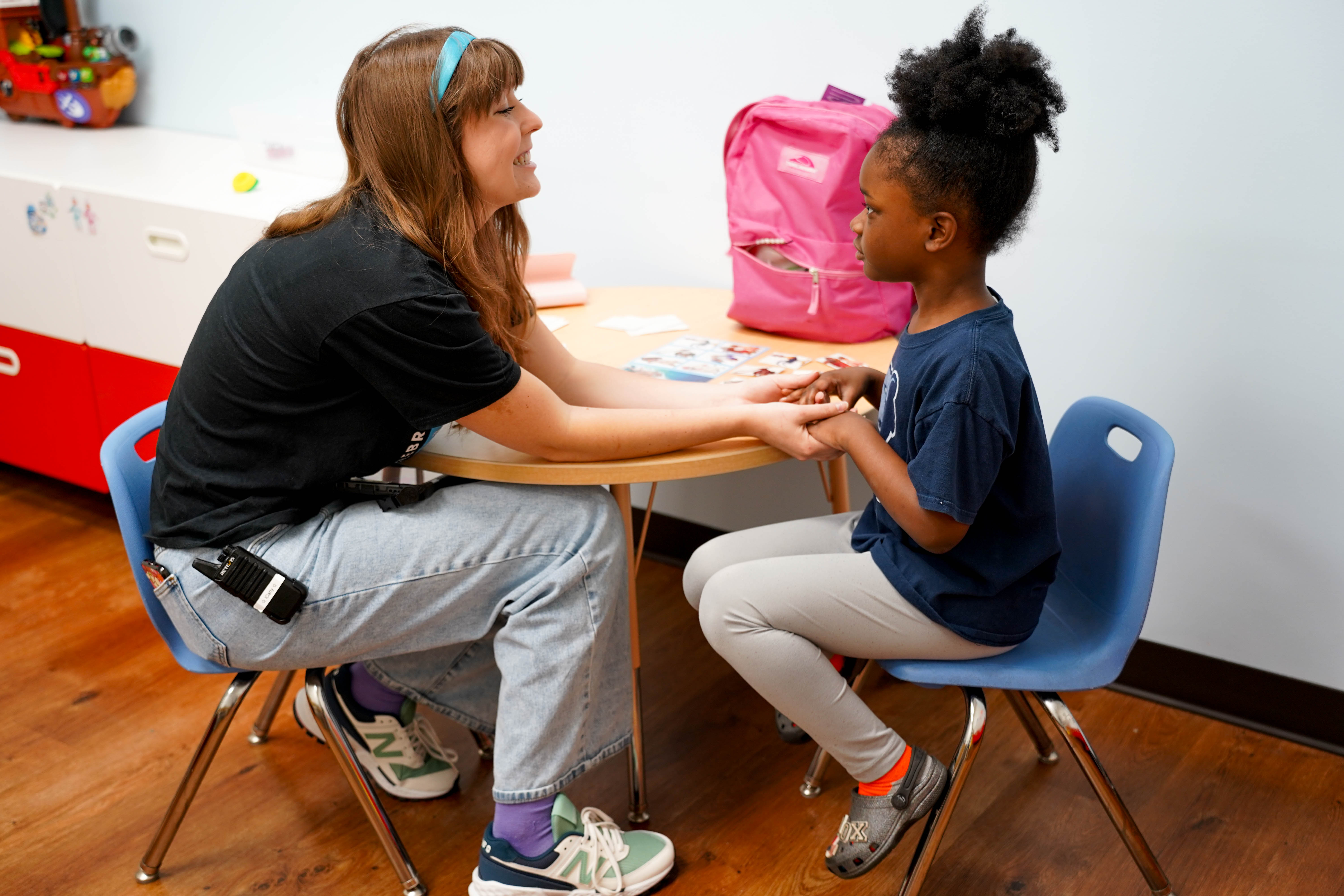
One-to-one structured teaching with a Registered Behavior Technician
MEASURED OUTCOMES
We measured our outcomes and published what we found
Behavioral Innovations conducted a retrospective analysis of 1,141 children using the Vineland Adaptive Behavior Scales, Third Edition (Vineland-3), a nationally normed assessment that measures how a child functions in daily life, not only how they perform in a therapy room.
At the individual level, session data is collected on every programmed goal and reviewed by your child's BCBA, who adjusts targets as the data indicates.
Children studied
To measurable progress
Average Vineland-3 composite gain
Average gain for children starting at age 2
Children showed measurable improvement in communication, social interaction and daily living skills within the first six months, with gains continuing through twelve months.
Children who began at age 2 recorded the largest average improvement of any age group in the study: +20.3 points on the Vineland-3 composite.
Children with moderate to higher support needs improved across all three domains. Some recorded the largest individual gains in the study.
This outcomes study measured change on the Vineland-3 over 6 to 12 months. Individual results vary with age, baseline skill level, therapy intensity and individual needs. Outcomes are not guaranteed.
CHOOSING A PROVIDER
Five questions to ask any ABA therapy company
ABA providers differ more than most families expect. These five questions separate the ones that are rigorous from the ones that are not.
Ask how many supervision hours your child's BCBA provides and whether that BCBA works in the center your child attends.
Your child's BCBA is present in the center daily, reviewing session data, adjusting goals and speaking with you directly.
Look for a plan built from a comprehensive functional assessment with measurable goals tied directly to that data.
Every treatment plan is built from comprehensive individual assessment. We do not run a standard curriculum or use template goals.
Session-level data is the minimum. Ask whether the provider measures outcomes at the program level using a standardized, nationally normed instrument.
We collect session data on every goal and have published a retrospective outcomes study of 1,141 children using the Vineland-3.
Skills learned in a center have to generalize at home. That requires structured caregiver instruction as a program component, not an occasional meeting.
Structured parent training is a defined component of every program, not an optional add-on or a periodic check-in.
Benefits verification, prior authorization timeline and expected out-of-pocket cost should be clear before your child's first session.
We verify your benefits, confirm authorization and tell you expected costs before anything begins.
120+ CENTERS
Find an ABA therapy center near you
Behavioral Innovations operates more than 120 centers in six states. Most centers have no waitlist or a minimal one. Autism assessment is available in Texas and Colorado.
| State | Markets | ABA Therapy | Evaluation | Social Skills | ABA Prep |
|---|---|---|---|---|---|
| Texas | |||||
| Oklahoma | |||||
| Colorado | |||||
| North Carolina | |||||
| Virginia | |||||
| Maryland |
Insurance and payment
We handle benefits verification before you commit
Most families use insurance to cover ABA therapy. Nearly all states require health plans to cover autism treatment. Medicaid is accepted in applicable states. Our team handles verification, prior authorization and billing.
Not seeing your plan? Call us at 855.782.7822.
Not seeing your plan? Call us at 855.782.7822.
Full Oklahoma insurance detailsNot seeing your plan? Call us at 855.782.7822.
Full Colorado insurance detailsNot seeing your plan? Call us at 855.782.7822.
Full Maryland insurance detailsNot seeing your plan? Call us at 855.782.7822.
Full Virginia insurance detailsNot seeing your plan? Call us at 855.782.7822.
Full North Carolina insurance detailsNot sure where to start?
Our intake team will tell you which service fits your child. You do not need a referral or a diagnosis to ask.
Family Stories
What families are saying
Families across our centers share what ABA therapy at Behavioral Innovations has meant for their children.
My son has only been here for a week and he LOVES it. By day 2 he just ran to the door and didn't even say bye to me lol. I knew this place was a great fit for him when he cried at the end of the evaluation because he didn't want to leave! Bailey was very thorough during the parent meeting to discuss my son's goals. So far all of the employees I've interacted with have been super kind! I HIGHLY recommend this location!
My kid LOVES ABA. I was terrified he'd hate it, but he wakes up excited to go to school. He has loved every single teacher he's worked with there and he's always had very strong stranger danger instincts. I've always followed his lead around people he doesn't want to be around so it makes this mama happy that he gets so excited to see the staff at ABA! The staff is communicative with great attitudes and it helps make him excited to learn. They are amazing!
We are so grateful for all the staff at BI. Every tech, BCBA, front desk staff has been such a joy to work with. This is our first experience with ABA therapy and it's been so great to see a program that uses ABA techniques in a positive way.
Common questions about ABA therapy
Questions families ask before, during and after starting ABA therapy.
What does ABA therapy mean?
ABA stands for applied behavior analysis. It is a therapy that teaches skills and reduces challenging behavior by identifying what triggers and maintains a behavior, then systematically teaching a functional alternative. It is the most extensively researched intervention for autism.
Who provides ABA therapy for children with autism?
ABA therapy is provided by Board Certified Behavior Analysts (BCBAs), who assess the child and write and supervise the treatment plan, and by Registered Behavior Technicians (RBTs), who deliver one-to-one therapy under that supervision. Behavioral Innovations employs both across more than 120 centers in six states.
What is the best ABA therapy program for a child with autism?
The best program is the one built from a comprehensive assessment of your specific child, supervised directly by a BCBA, measured with session-level data, and paired with structured parent training. Ask any provider how they individualize plans and how they measure progress at the program level.
How do I find an ABA therapy company near me?
Does ABA therapy work?
Yes. ABA is among the most extensively researched interventions for autism. Our internal analysis of 1,141 children found an average gain of +12.3 points on the Vineland-3 composite score, with measurable improvement in communication, social interaction and daily living skills typically appearing within the first six months.
Read the full outcomes studyHow long does it take to see results from ABA therapy?
Most children in our outcomes study showed measurable Vineland-3 progress within six months, with gains continuing through twelve months. Early changes usually appear first in communication and behavioral regulation. Families often notice differences at home before they appear in a formal report.
ABA therapy progress over timeAt what age should a child start ABA therapy?
ABA therapy can begin as early as 18 months. In our outcomes study, children who began at age 2 recorded the largest average gains of any age group. Children benefit at older ages as well. Behavioral Innovations serves children from 18 months through 10 years.
How many hours per week of ABA therapy does a child need?
Recommended intensity typically ranges from 20 to 40 hours per week and is set by comprehensive assessment, reflecting the child's age, skill profile, goals and family circumstances. Insurance authorization may also affect approved hours. Your BCBA reviews the recommendation with you before therapy begins.
Does insurance cover ABA therapy?
Yes, in most cases. Nearly all states require health plans to cover autism treatment including ABA, and Medicaid covers medically necessary ABA for children with an autism diagnosis. Most families pay only their plan's copay, coinsurance or deductible. We verify your specific benefits before services begin.
Insurance coverage for ABAIs ABA therapy only for autism?
ABA is most extensively researched in autism and is most commonly authorized by insurance for children with an autism diagnosis. The underlying principles apply more broadly to communication delays, behavioral challenges and adaptive skill deficits. A diagnostic evaluation determines whether ABA is appropriate for your child.
What is the difference between center-based and in-home ABA therapy?
Center-based ABA delivers therapy in a purpose-built clinical space with on-site BCBA supervision, peer access for social skill practice, and a structured environment that prepares children for classroom settings. In-home ABA is delivered in the family's environment. Behavioral Innovations is center-based.
Center-based vs. in-home ABADo I need an autism diagnosis before starting ABA therapy?
Insurance generally requires a diagnosis to authorize ABA therapy. In Texas and Colorado, Behavioral Innovations provides the evaluation, so families can complete testing and begin therapy with the same organization. In other states, we can begin once you have a diagnosis from a qualified provider.
No Referral Required
Get started with Behavioral Innovations
Our intake team will walk you through which service fits your child and what comes next.
- Speak with our intake team directly
- Find out which service fits your child
- Schedule an evaluation or begin enrollment
- No referral or diagnosis required to ask