Most children in our outcomes study showed measurable progress within the first 6 months of ABA therapy. Early improvements typically appear first in communication and behavioral regulation, with continued gains building through 12 months and beyond. Progress varies by child, but consistent, individualized therapy produces steady development over time.
Contáctenos Hoy Para Empezar
Su información nos ayudará a conectarle de inmediato con uno de nuestros especialistas en admisión.
Measured progress in communication, independence, and everyday life skills – Backed by real data and clinical expertise.
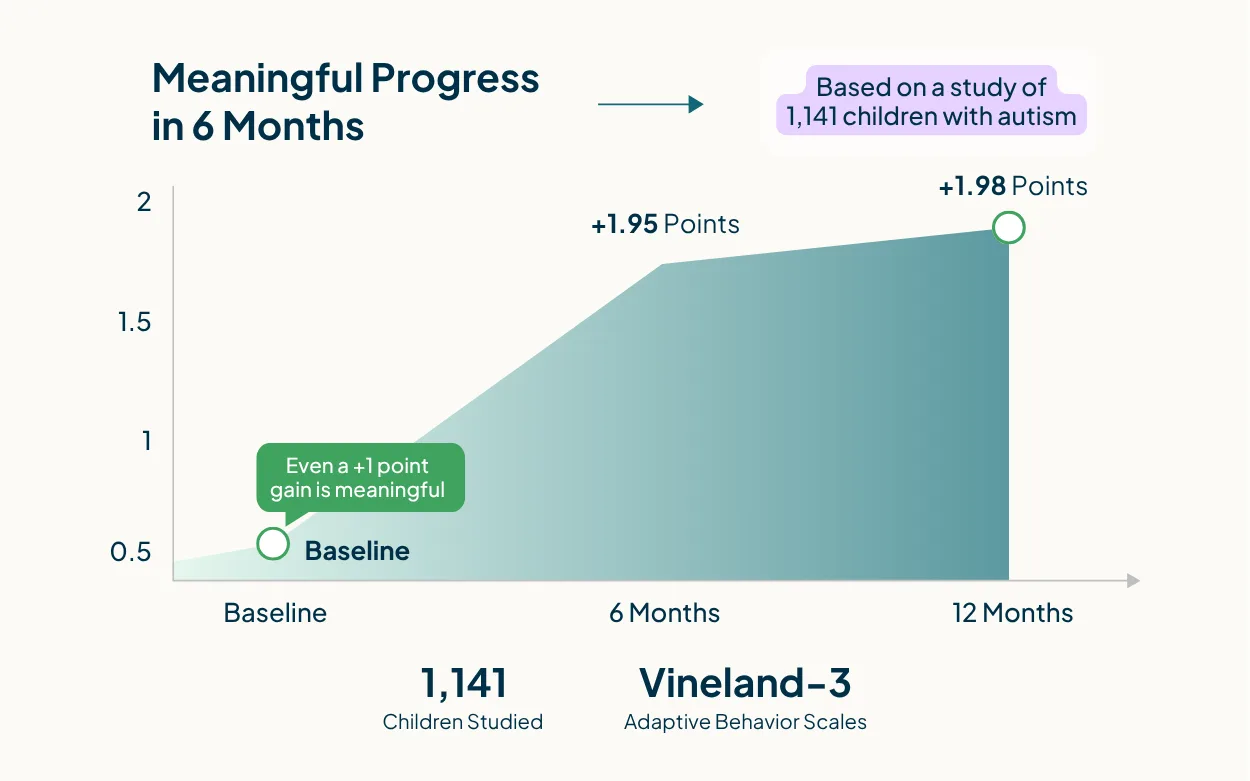
At Behavioral Innovations, we track progress the way it should be tracked – clearly, consistently, and in ways that matter to families. We tracked 1,141 children across our programs and measured exactly how much – and in what ways – using a nationally recognized assessment tool. Here’s what we found.
- 1,141 children studied
- Outcomes tracked using Vineland-3 standardized assessments
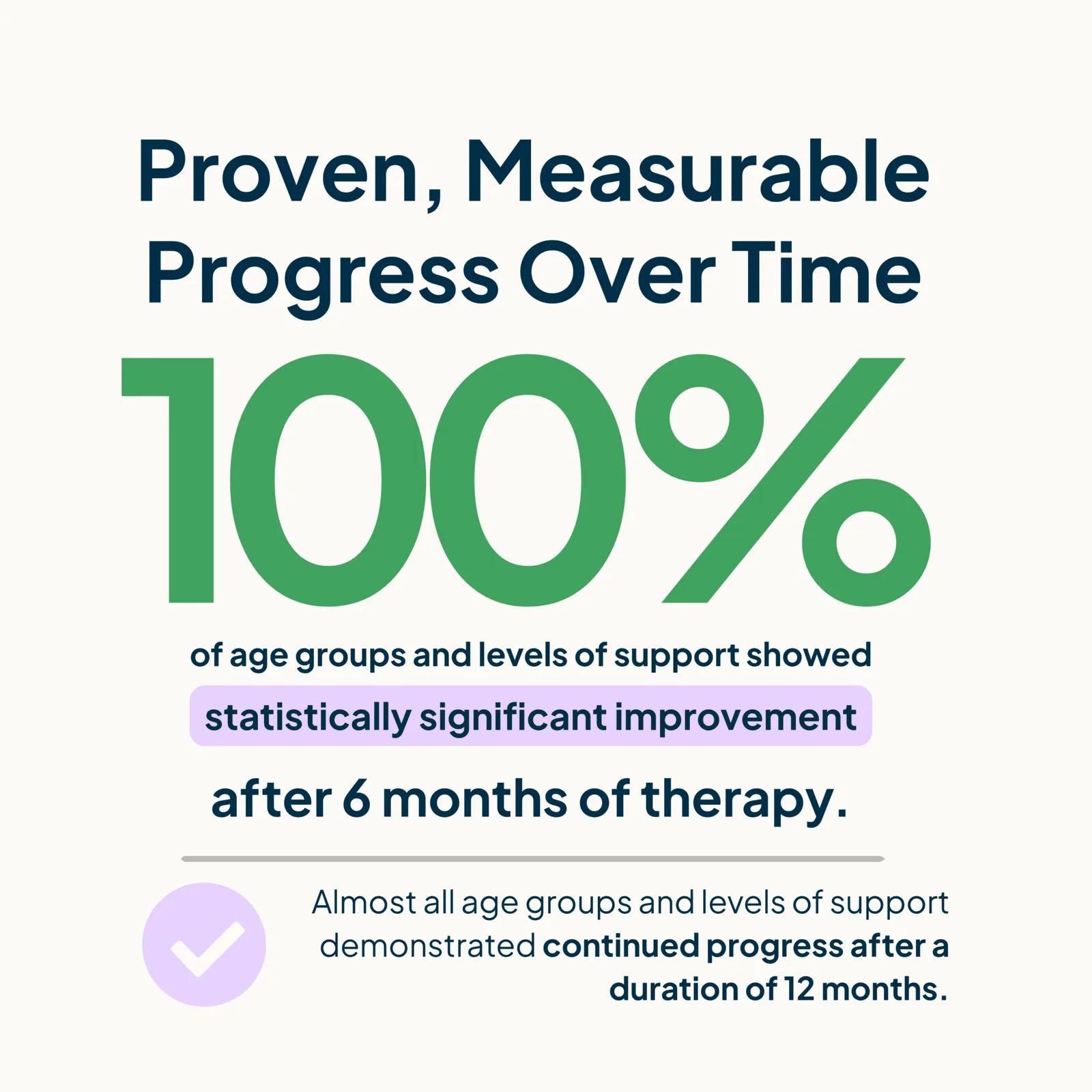
- Meaningful progress measured within 6 months
- Gains seen across all ages and support levels
Even small gains matter. In standardized assessments, just a +1 point improvement is considered clinically meaningful.
Niños objeto del estudio
1,141
Standardized Assessments
Early Start Gains
+20.3
Progress at Age 2
High Growth
+12.3
Results Across All
How we measure ABA therapy outcomes
Behavioral Innovations measures ABA therapy outcomes using the Vineland Adaptive Behavior Scales, Third Edition (Vineland-3) – a nationally recognized standardized assessment that tracks how children function in real-world situations, not just during therapy sessions. Progress is measured in communication, social interaction, and daily living skills across three domains.
Most assessments measure what a child can do in a clinical setting. The Vineland-3 measures what a child actually does in everyday life – at home, during routines, with family and peers. That’s a meaningful distinction. A child who can follow an instruction in a therapy room but still can’t communicate a need at the dinner table hasn’t made the kind of progress that matters most.
The Vineland-3 tracks three core adaptive behavior domains:
Communication
How a child expresses their needs, understands language, and uses words, gestures, or other means to connect with others.
Social interaction
How a child engages with family members, peers, and others – including play, turn-taking, and reading social situations.
Daily living skills
How independently a child manages everyday tasks – dressing, eating, following routines, and functioning at home.
On the Vineland-3 scale, a gain of just +1 point is considered clinically meaningful. This is a high-resolution tool – small numbers represent real, observable changes in a child’s daily life. The gains BI children showed are measured against this standard.
What our outcomes study found
Measurable progress within 6 months – across all starting points
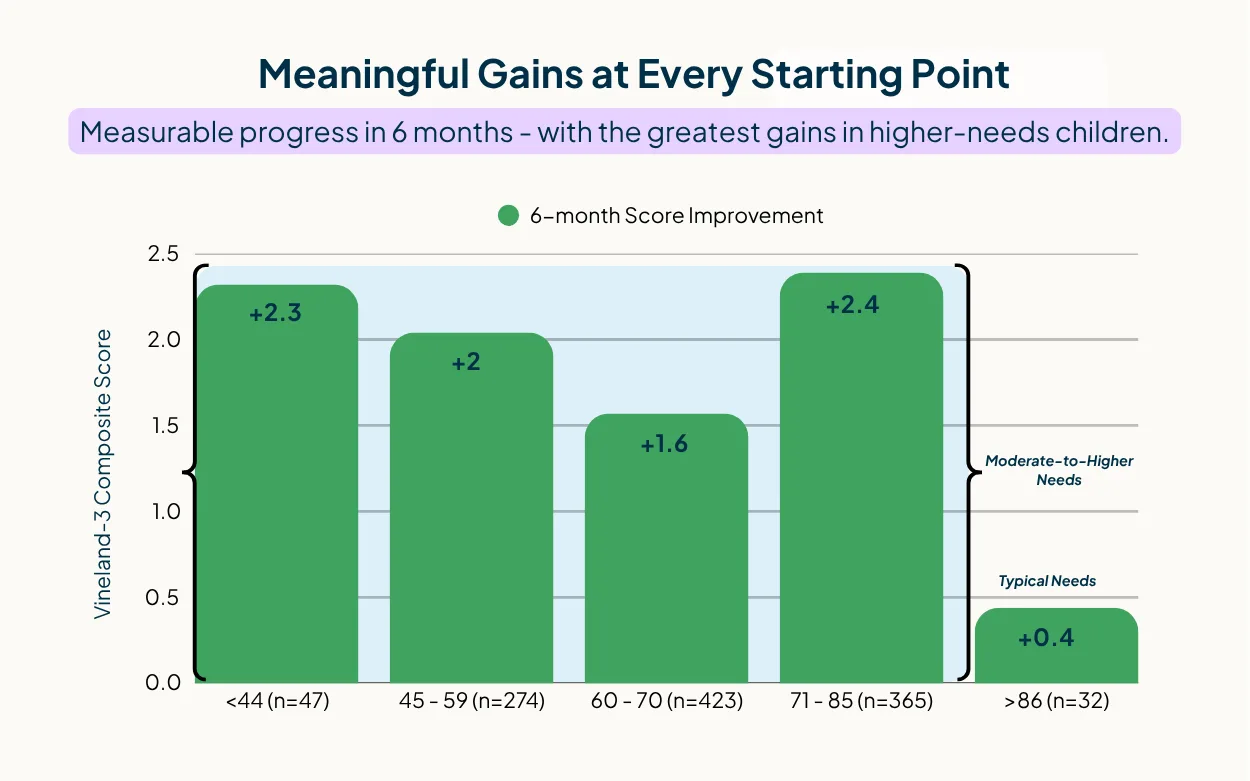
Children across all initial skill levels showed meaningful gains within the first six months of ABA therapy. This is significant because it demonstrates that progress is not limited to children who enter therapy with stronger baseline skills. Children with higher support needs – who enter therapy with lower adaptive behavior scores – showed consistent improvement as well.

Progress in just six months
- Measurable improvement within months
- Growth in communication and behavior
- Early signs families can see at home

Start early, gain more
- Biggest gains seen at age 2
- Over 20-point improvement in key skills
- Early therapy drives faster progress
Results for high needs
- Strong progress for moderate support needs
- Meaningful gains across skill areas
- Consistent improvement over time
Real Change at Home
- Better communication with family
- Improved social interaction
- Increased independence in daily life
What this means for your child
For many families, progress means:
- Saying first words or communicating needs clearly
- Playing and engaging more with others
- Completing everyday routines with less support
- Fewer moments of frustration or challenging behavior
Even small improvements can have a meaningful impact. In standardized assessments, just a +1 point gain is considered clinically meaningful.

Por qué es importante empezar pronto
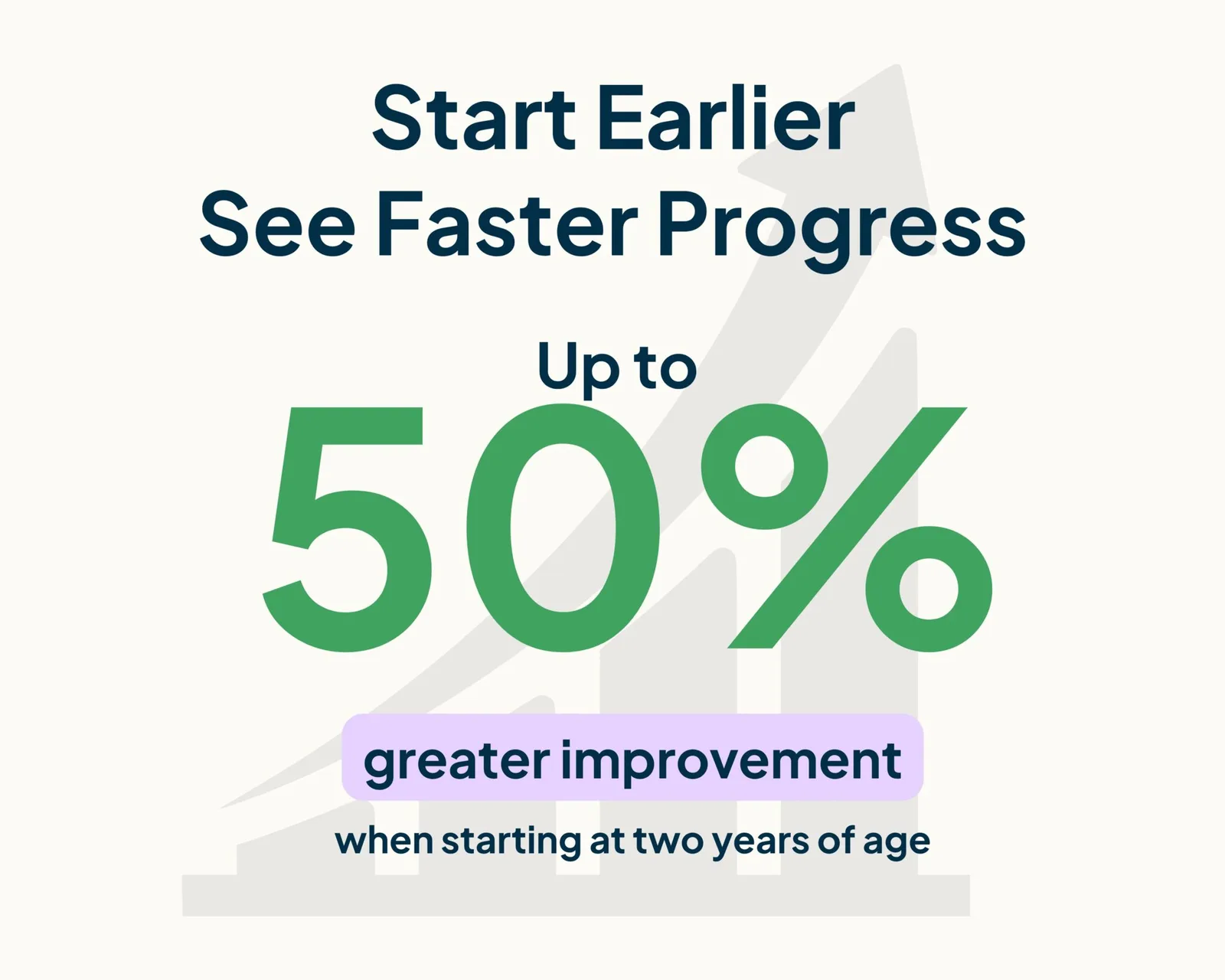
The biggest gains happen at age 2 – a +20.3 point improvement.
Children who begin ABA therapy earlier see the biggest gains in communication, social skills, and independence.
- Faster development of communication skills
- Stronger social engagement at a younger age
- Greater independence in everyday routines
- More opportunity for long-term growth
+12.3 point average gains across all children studied
Across all 1,141 children in the study – regardless of age, starting skill level, or support needs – the average improvement on the Vineland-3 composite score was +12.3 points. This is more than twelve times the threshold for clinical significance on this assessment.
Stronger progress where it matters most
Children with higher support needs show strong, consistent progress
A common concern among parents of children with more significant support needs is whether ABA therapy will produce meaningful gains for their child specifically. BI’s data shows it does. Children with moderate to higher support needs – measured by lower initial Vineland-3 scores – showed meaningful improvement across all three domains, with some showing the largest individual gains in the study.
What this means for you as a parent
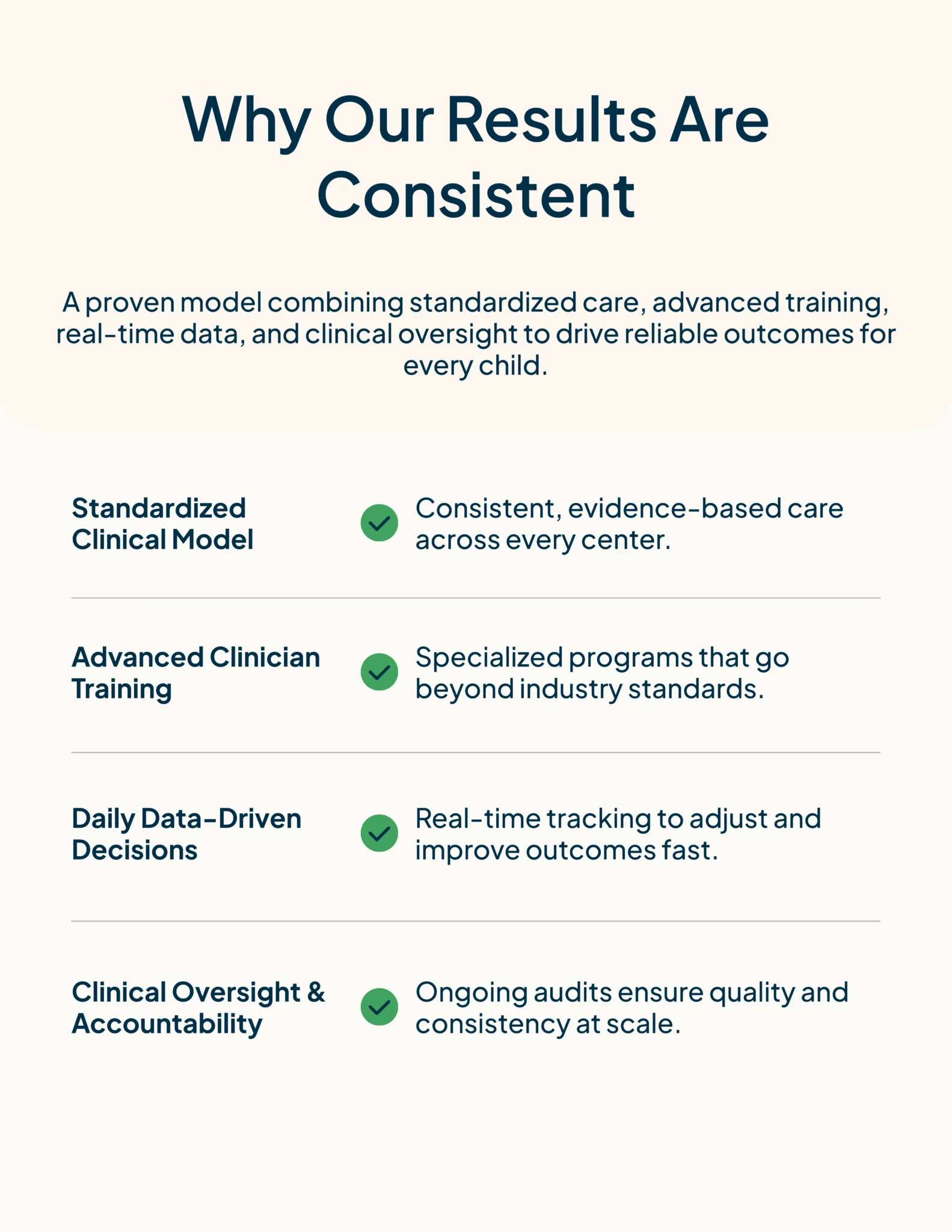
ABA therapy is not only effective for children who are mildly affected. The structured, individualized nature of ABA – with BCBA oversight, data collection every session, and goals adjusted in real time – is specifically designed to work for children with more complex needs. The outcomes data backs this up.
Does ABA therapy actually work?
Yes. ABA therapy is one of the most extensively researched interventions for autism spectrum disorder, and Behavioral Innovations’ internal outcomes data across 1,141 children confirms what the broader research shows: children make measurable, meaningful gains in communication, social skills, and daily living skills – most within the first six months of consistent therapy.
- Many families notice meaningful changes within the first six months
- Progress builds over time, with continued growth after a full year of therapy
- Children at different ages and needs levels all show improvement in their own way
This isn’t just about data – it’s about your child communicating more, connecting more, and gaining their independence.
Results you can trust
ABA therapy is one of the most widely researched and recommended treatments for autism, helping children improve communication, behavior, and independence. At Behavioral Innovations, we combine this evidence-based approach with individualized care to deliver meaningful, measurable outcomes.
Common questions about ABA therapy outcomes
What progress looks like from a parent’s perspective

El equipo se ha mostrado increíblemente comprensivo, paciente y competente desde el primer día. Se preocupan de verdad por el progreso de cada niño y hacen que las familias se sientan escuchadas y…
El equipo se ha mostrado increíblemente comprensivo, paciente y competente desde el primer día. Se preocupan de verdad por el progreso de cada niño y hacen que las familias se sientan escuchadas e incluidas en cada paso del camino. Ya he notado una evolución positiva en mi hijo, y estoy muy agradecida por su dedicación y compasión. ¡Lo recomiendo encarecidamente a cualquier familia que esté empezando su camino con el autismo!
Susan O Abril de 2026
Behavioral Innovations es una de las mejores decisiones que he tomado por mi hijo. Me ponía muy nerviosa dejar a mi hijo, que por entonces aún no hablaba, en algún sitio durante…
Behavioral Innovations es una de las mejores decisiones que he tomado por mi hijo. Me ponía muy nerviosa dejar por primera vez a mi hijo, que por entonces aún no hablaba, en un sitio, pero este centro nos ha ayudado muchísimo a nuestra familia. Siento que el personal se preocupa de verdad por mi hijo y utiliza técnicas que se adaptan a su forma de aprender, haciéndolo divertido, ¡y además me apoyan a mí como madre! Ha avanzado mucho, ha crecido muchísimo y ahora hace cosas que no estaba segura de que fuera capaz de hacer, gracias a Behavioral Innovations.
Talia M Abril de 2026
¡Behavioral Innovations ha cambiado la vida de mi familia! Mi hijo lleva acudiendo allí dos años y ha supuesto un cambio enorme. Le encanta ir,…
¡Behavioral Innovations ha cambiado la vida de mi familia! Mi hijo lleva acudiendo allí dos años y ha supuesto un cambio enorme. Le encanta ir, y ha sido increíble ver todo el crecimiento y los progresos que ha logrado. Todo el personal es maravilloso: el personal de recepción es muy amable y los terapeutas son increíbles, se preocupan de verdad por los niños. ¡Lo recomiendo encarecidamente!
Jessica K Abril de 2026
El personal de aquí se porta de maravilla con mi hijo y le ha ayudado de muchas maneras. Aunque solo han pasado unos meses,…
El personal de aquí se porta de maravilla con mi hijo y le ha ayudado de muchas maneras. Aunque solo han pasado unos meses, ¡ha progresado muchísimo y sigue aprendiendo cosas nuevas cada día! La actitud positiva que se respira en este centro es, sin duda, una de sus mejores cualidades. Responden a todas mis preguntas y dudas de forma rápida y eficaz. ¡Muchísimas gracias al equipo de BI!
Shelby B Abril de 2026
La atención que se presta en BI es realmente excepcional. Siempre ofrecen una atención personalizada a cada persona, demostrando un interés profundo y sincero por cada niño…
La atención que se presta en BI es realmente excepcional. Siempre ofrecen una atención personalizada a cada persona, demostrando un interés profundo y sincero por cada niño que recibe sus servicios. Desde el personal de recepción hasta todo el equipo que trabaja entre bastidores, se nota que les encanta lo que hacen.
Mayra B Abril de 2026
Para criar a un niño con autismo se necesita a todo un pueblo, y puedo decir con mucho gusto que todos los que formamos parte de BI somos una familia. Mi hijo lleva aquí…
Para criar a un niño con autismo se necesita todo un pueblo, y puedo decir con alegría que todos los que formamos parte de BI somos una familia. Mi hijo lleva aquí poco más de un año y ¡cada paso del camino ha sido increíble! Desde el día en que me pasé por el centro para echar un vistazo, la directora me recibió con una sonrisa enorme y una energía muy acogedora. ¡Desde ese mismo día supe que este era el lugar donde teníamos que estar! La comunicación aquí es estupenda y siempre me mantienen al día de todas las cosas increíbles que mi hijo está consiguiendo. Sinceramente, no sé dónde estaría sin el increíble cariño y apoyo del equipo de Behavioral Innovation.
Alyssa G abril de 2026
Behavioral Innovations ha sido un lugar fantástico para mi hijo pequeño. Desde que acude a diario, ha progresado muchísimo tanto en la comunicación como en sus habilidades generales.…
Behavioral Innovations ha sido un lugar increíble para mi hijo pequeño. Desde que acude a diario, ha progresado muchísimo tanto en la comunicación como en sus habilidades generales. Ha pasado de no hablar a expresarse ahora de formas que antes pensábamos que tardaría mucho más en conseguir. El personal es paciente, comprensivo y está verdaderamente comprometido con el desarrollo de cada niño. Estoy muy agradecida por el impacto positivo que han tenido en su desarrollo. ¡Gracias al personal, a los RBT y a los BCBA de BI por vuestro servicio y apoyo! ¡Sin duda lo recomiendo a cualquier padre o madre que quiera que su hijo prospere!
Aileen C abril de 2026
Mis hijos se sienten muy seguros y bien atendidos en Behavioral Innovations. Están aprendiendo constantemente a superar retos y adquiriendo habilidades que les ayudan…
Mis hijos se sienten muy seguros y bien atendidos en Behavioral Innovations. Aprenden constantemente a superar retos y adquieren habilidades que les ayudan en su vida cotidiana. Apreciamos de verdad la atención excepcional que nos brinda el personal de Behavioral Innovations.
Jenna V Abril de 2026
Mi hijo lleva ya dos años acudiendo a Behavioral Innovations y ¡no podríamos haber elegido un lugar mejor para que reciba terapia! Todos…
Mi hijo lleva ya dos años acudiendo a Behavioral Innovations y ¡no podríamos haber elegido un lugar mejor para que reciba terapia! Aquí todo el mundo es estupendo, desde los BCBA hasta los RBT. ¡Recomendamos Behavioral Innovations a cualquiera que esté empezando su andadura con el ABA o que esté buscando un cambio!
Mónica M marzo de 2026
Estoy muy agradecida a esta clínica de terapia ABA porque he observado cambios significativos en mi pequeño. De verdad veo cómo va creciendo poco a poco…
Estoy muy agradecida a esta clínica de terapia ABA porque he observado cambios significativos en mi pequeño. De verdad veo cómo crece poco a poco y cómo se siente como en casa, ya que, gracias al cuidado, la seguridad y la empatía de su personal cualificado, ¡mi hijo mejora cada día más y más!
Ana M marzo de 2026
Aviso legal: Este estudio de resultados se basa en un análisis retrospectivo de niños que recibieron terapia ABA en Behavioral Innovations. Los resultados reflejan los cambios medios medidos mediante las Escalas de Comportamiento Adaptativo de Vineland (Vineland-3) a lo largo de un periodo de entre 6 y 12 meses. Los resultados individuales pueden variar en función de factores como la edad, el nivel de habilidades inicial, la intensidad de la terapia y las necesidades individuales. Aunque las mejoras observadas fueron estadísticamente y clínicamente significativas, los resultados no están garantizados y no deben interpretarse como representativos de todos los niños.